
Faithfulness
What could be more necessary?

When your heart aches with each beat, and your soul feels bruised and battered, it matters that you still show up. When it is easier to walk away, and yet you endure. This is the Church.
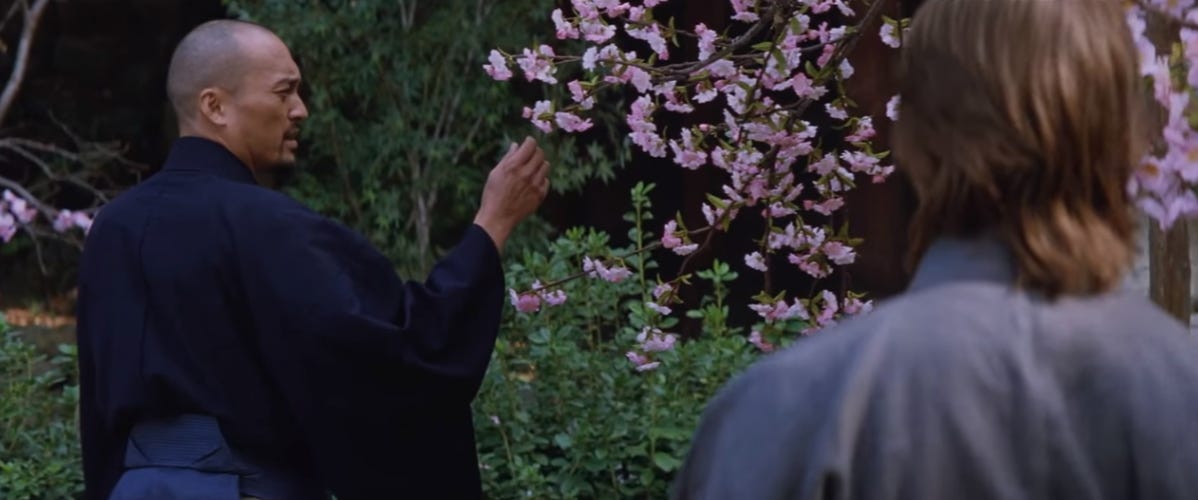
The 2003 movie The Last Samurai is, in my personal opinion, a very underrated film. It is actually one of my favorite movies of all time. From the haunting soundtrack by Hans Zimmer (which I am listening to as I write this) to the character-driven plot full of stillness and weight with sweeping cinematic moments, the layers of story being told are profound.
Nathan Algren, an American war captain, is not the hero of the film. He is a man unraveling from the haunted weight of his past. And yet, we see a determined resilience to keep going— even if he is half numb from the alcohol. There is this innate tenacity that seems to pour out of him whenever most people would surrender. We see a man desperate for peace and unable to find it. He is a man struck down by life and circumstances, but he is also a man who continues to get back up. His messy, imperfect, non-hero self. Over and over again.
Tracing this theme through the film brings a swell of emotions because I think we can all relate to being that man. One marked not by strength but a refusal to quit, even when it hurts. Or at least we would like to be.
This ferocious will to live and keep fighting even in the midst of loss is what gains the attention of rebel leader Katsumoto, who takes him home to his quiet samurai village.
There, Algren’s wounds start to heal. His physical ones and his emotional/mental ones as well. Over time, Algren gets to know his captors, their language and culture, overcomes his alcoholism, and finds the inner peace that has eluded him for so long. Despite being haunted by his past and struggling with severe guilt, Algren finds peace and purpose in the village. He overcomes his desire to die, learning from the Samurai that there is “life in every breath”.
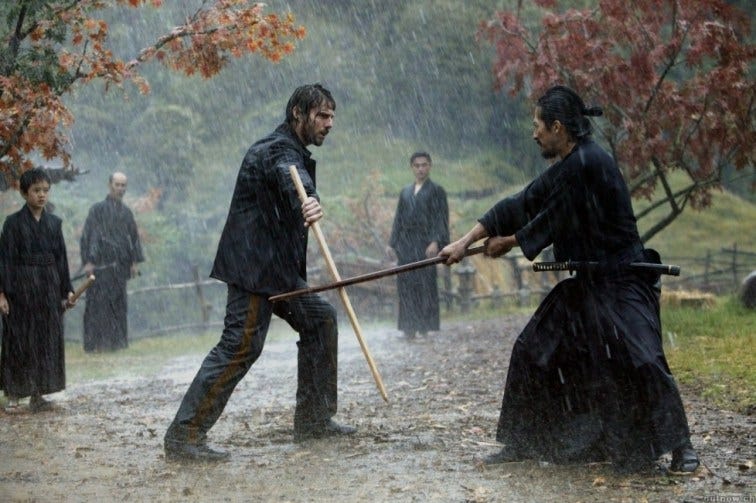
But this peace is hard fought. In the scene depicted above, Algren joins the men of the village in a round of training. Ujio has a particular dislike for the American soldier and decides to take it out on him in this scene. Algren is beaten without ceremony. He is wildly outmatched, outtrained, and deeply unwelcome. And still, he stands. He continues to get back up and fight, even as he grows more and more unsteady. There is nothing romantic about this scene. It is a rainy mess of mud and blood. There is no victory here. This theme is repeated over and over again. You feel the deep pain he fights through. The movie does a beautiful job through its visual poetry to depict the struggle well, which resonates deeply with those who view it.
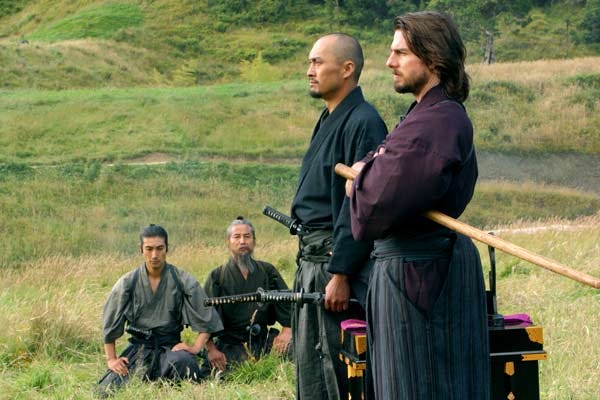
It can be so much easier to cheer on endurance when it ends in victory. We read stories of heroes who conquer their enemies and proclaim, “Of course that was worth it!” But what is our response when our suffering, pain, hurt, and endurance have no apparent or immediate triumph?
The Western church, with our luxuries and Stoic philosophy, has decided that if it is too uncomfortable or painful, it is our right and duty to walk away. Perseverance is something for other believers.
Let me tell you, as someone who has been in ministry for a while: perseverance in the church rarely looks like winning.
Many times it looks like staying when you have been misunderstood and even maligned. Most of the time, it is loving well even when that love is not returned. It is continuing in obedience, with open wounds and a tired soul.
When those wounds come not from the Enemy, but brothers and sisters in Christ, it can feel easier— reasonable even — to simply drop the weight of our cross and walk away. “Not worth it.”
But the Called are not beckoned towards an earthly comfort. Those on the front lines are invited to faithfulness and long obedience. There is something in that relentless rising that eventually commands a response, even if it’s not on this side of eternity. This is something unteachable that is forged only in suffering. The quiet refusal to abandon Truth, Beauty, Goodness when it becomes costly is the kind of endurance those in the Church need, and yet so many do not have.
Romans 5 “Therefore, since we have been justified by faith, we have peace with God through our Lord Jesus Christ. 2 Through him we have also obtained access by faith into this grace in which we stand, and we rejoice in hope of the glory of God. 3 Not only that, but we rejoice in our sufferings, knowing that suffering produces endurance, 4 and endurance produces character, and character produces hope, 5 and hope does not put us to shame, because God’s love has been poured into our hearts through the Holy Spirit who has been given to us.”
James 1 “2 Consider it pure joy, my brothers and sisters,[a] whenever you face trials of many kinds, 3 because you know that the testing of your faith produces perseverance. 4 Let perseverance finish its work so that you may be mature and complete, not lacking anything.”
Galatians 6 “9 Let us not become weary in doing good, for at the proper time we will reap a harvest if we do not give up. 10 Therefore, as we have opportunity, let us do good to all people, especially to those who belong to the family of believers.”
Luke 9 “23 And he said to all, “If anyone would come after me, let him deny himself and take up his cross daily and follow me. 24 For whoever would save his life will lose it, but whoever loses his life for my sake will save it.”
Just like for Algren, peace does not descend into his lap overnight. It is learned, fought for, and received breath by breath. He must learn to lay down old patterns, and choose—daily, deliberately—to live not just for himself but for something bigger.
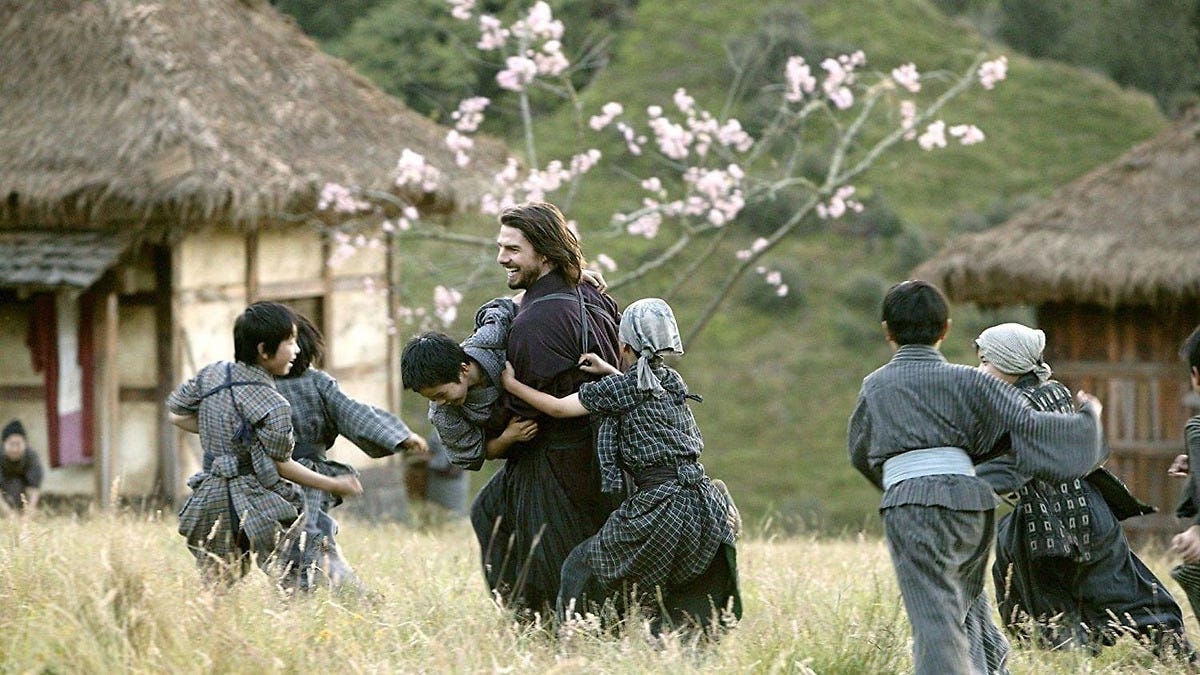
A faith that withers under pressure is not rooted deeply enough. A love that retreats at the first wound has not been perfected. The Church does not need more people who only serve in ideal conditions. It needs men and women who, by grace, learn how to remain. Even when it costs them reputation, comfort, ease, etc. Not because the Church and its people are always gentle or perfect, but because Christ is always faithful even in our failures. He is our peace and comfort.
Here is the thing: as finite, fallen humans, we do not have enough grit to persevere or endure on our own. We will fail. We will all die of our wounds one day.
That is why we need One who can save us. Christ Himself walked the path of relentless endurance. He was misunderstood, rejected, struck down, and yet never turned aside from the will of the Father. He never claimed it wasn’t worth the hurt. Not once. Not even unto death. And because He endured, those who belong to Him are not left to manufacture strength from within ourselves. We are given His Spirit, who is full of sustaining grace. Praise God for that!
We are held by the sustainer of the universe. And because of that beautiful truth, we can endure in the pain. And as we endure (not just after), we can point others to the One who wants to hold them and their pain as well.
“Nations, like men, it is sometimes said, have their own destiny. As for the American Captain, no one knows what became of him. Some say that he died of his wounds. Others, that he returned to his own country. But I like to think he may have at last found some small measure of peace, that we all seek, and few of us ever find...”
This is part 1 addressing those who walk away bc of church hurts. Part 2 will address leadership and their biblical responsibility to care well for those the Lord has entrusted to them. This conversation isn’t an either/or but rather a both/and. Please know that I would never excuse or tolerate church abuse. But I do believe that many in the church walk away too easily most of the time.
I was going to write a part 2, but this article, “Elders Smell Like Sheep,” does the job better than I probably could. I highly recommend reading it.
**subtitle was inspired by something I read, but I cannot remember the source.
I recommend listening to The Last Samurai soundtrack as you read this. Enjoy!